Laurence Belzile
Biography
Born in 1994 in Gaspésie (QC), on the unceded territory of the Mi'kmaq Nation, Canadian artist Laurence Belzile holds a Bachelor of Fine Arts from Concordia University (2016), with a major in painting and drawing, as well as a Master of Fine Arts from Université Laval (2019). Since 2016, Laurence Belzile has presented her work in both group and solo exhibitions across Canada, including at the Vernon Public Art Gallery (BC), the Richmond Art Gallery (BC), Galerie Montcalm (QC), the Centre d’art de Kamouraska (QC), and Galerie Champagne et Paradis (QC). Her work has been supported, among others, by the Canada Council for the Arts. Her artworks are part of the public collection of the City of Boucherville and the Méduse Collection of the City of Québec.
Artist Statement
My practice centers on abstract painting and drawing from a feminist perspective.
It is grounded in the belief that emotions and subjectivity constitute forms of knowledge in their own right, forms that have historically been undervalued in dominant narratives of art, particularly when associated with women’s practices. My work seeks to move these dimensions from the realm of the intimate into the public sphere, considering them as shared meaningful experiences.
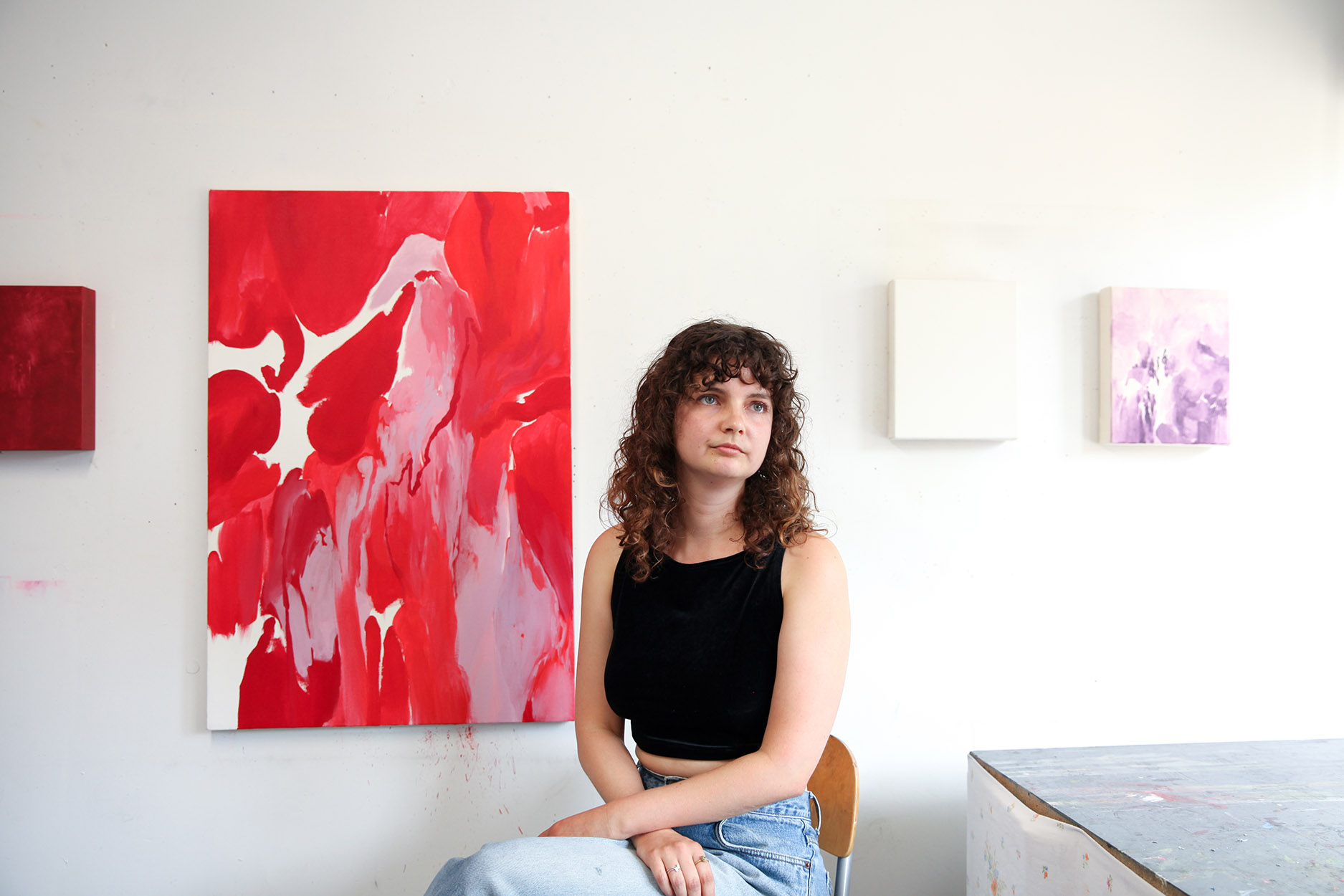
For me, abstraction is a poetic space, outside the constant productivity imposed by the contemporary context. I construct images in which sensations take shape through color, rhythm, and gesture interrelations. My works are characterized by organic forms, curved lines, and chromatic contrasts that delineate distinct zones within the pictorial surface. The compositions, mostly vertical, are conceived as tensions: elevation, descent, suspension, enclosure, and openness coexist.
Melancholy runs through my work as a contained intensity. It appears in the restraint of gesture, through interrupted or compressed marks, and in color combinations where light remains present despite density. The work becomes a space where emotion is set into motion.
Scale plays a determining role in the experience of the works. More intimate formats encourage an attentive and introspective relationship, while large-scale works engage the body and the movement of the gaze. In both cases, I seek to create situations in which the viewer is invited to slow down, to move between details and the whole, and to temporarily inhabit a sensitive space. The sharing of sensations, more than the transmission of a precise message, lies at the heart of my practice.
My work exists in dialogue with the practices of women artists of the past within a feminist perspective grounded in the circulation of knowledge, forms, and creativity. I question the idea of the artist as a singular and isolated figure, favoring instead a conception of creation as a shared space. In this sense, my work participates in a critical reflection on art history, its hierarchies and exclusions, while reaffirming the capacity of abstraction to generate complex, contemporary, and collective emotional experiences.